In pharmaceutical manufacturing, a single airborne dust particle can become a serious risk to product quality and patient safety. Dust, microorganisms, or chemical particles carried by airflow into the production area can compromise an entire batch of sterile product.
This is exactly why the HEPA filter (High-Efficiency Particulate Air) plays a central role in protecting the cleanroom environment. The latest version of Annex 1 (EU GMP) also emphasizes the importance of a comprehensive Contamination Control Strategy (CCS), in which the air filtration system is an indispensable link.
This article will help you understand the operating principle, the common types of HEPA filters used in the pharmaceutical industry, qualification requirements, and key considerations for selection to ensure GMP compliance.
What Is a HEPA Filter?
A HEPA filter is a high-efficiency air filter capable of capturing at least 99.995% of particles sized 0.1–0.2 microns — the size range considered hardest to filter, known as the MPPS (Most Penetrating Particle Size).
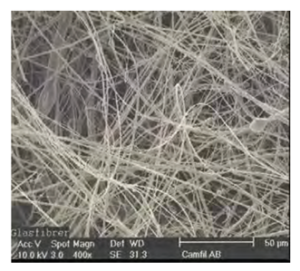
This performance is achieved through a combination of several filtration mechanisms, allowing the filter to capture both coarse dust particles and extremely fine microorganisms. The filter structure typically consists of ultra-fine glass fiber arranged into a dense mesh, forming a winding path that forces dust particles to become “trapped” as air passes through.
Unlike ordinary filters that only block large particles, HEPA filters are designed to maintain stable airflow while achieving extremely high particle-capture efficiency — a mandatory condition in environments requiring strict contamination control.
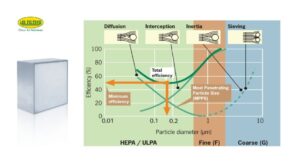
Filtration Mechanisms of HEPA Filters
A HEPA filter does not work like a simple mesh that only blocks large particles. Instead, it relies on multiple physical mechanisms simultaneously to capture particles of very different sizes.
Interception
When a dust particle travels along the airflow and passes close enough to a filter fiber, it adheres to it. This mechanism is mainly effective for particles in the 0.1–1 micron range — where inertia is not yet strong enough to cause direct impact, but the distance is close enough for the particle to “stick” to the fiber. This mechanism is important for bacteria and fungal spores.
Impaction
Particles larger than about 0.5 microns have enough inertia that they cannot “follow” the curved path of the airflow around a fiber. Instead, the particle separates from the airflow and strikes the fiber surface directly. This mechanism is particularly useful for removing agglomerated dust, pollen, or large microbial clusters.
Diffusion
Ultra-fine particles, under 0.1 microns, do not travel in a stable straight line but move erratically due to continuous collisions with air molecules (Brownian motion). This random movement increases the likelihood of the particle striking a fiber and being captured. This is the dominant mechanism for capturing viruses and ultra-fine aerosols.
Sieving
Although not the primary mechanism of HEPA filtration, sieving still occurs when a particle is simply too large to pass through the gap between fibers. This mechanism supports the three mechanisms above.
Why Is 0.1–0.3 Micron the Hardest Size to Filter?
At around 0.1–0.2 microns, dust particles fall into an efficiency “valley”: too large to be effectively captured by diffusion, yet too small to be easily intercepted or impacted. This is why standards such as EN 1822 and ISO 29463 use 0.1–0.2 microns as the benchmark for testing HEPA filter performance. If a filter achieves ≥99.97% at this size, its efficiency for larger or smaller particles is typically even higher.
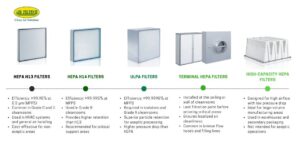
Common Types of HEPA Filters in the Pharmaceutical Industry
Depending on the required cleanliness level, airflow characteristics, and regulatory requirements, each pharmaceutical production area needs a suitable type of filter.
Standard HEPA Filters (H13, H14)
According to DIN EN 1822-1, HEPA filters are classified by efficiency:
- H13: captures at least 99.95% of particles at the MPPS
- H14: captures at least 99.995% of particles at the MPPS
This group is typically used for HVAC systems supplying air to Grade C and D cleanrooms, or areas classified as ISO Class 7–8. H14 is generally preferred when higher cleanliness is required, such as background areas for Grade B.
ULPA Filters
ULPA (Ultra-Low Penetration Air) filters offer superior performance to HEPA, achieving at least 99.9995% efficiency at the MPPS. This type is typically used for sterile isolators and Grade A areas — where the strictest particle control is required.
Note: the higher the efficiency, the greater the pressure drop across the filter, requiring a stronger fan system to compensate.
Terminal HEPA Filters
This type is installed at the final point of the air supply system, typically on the ceiling or wall of the cleanroom — serving as the “last line of defense” before air comes into direct contact with critical production areas. It is common in Grade A/B areas, particularly above laminar airflow hoods or filling lines.
The advantage of this type is direct control of cleanliness at the point of use, while integrity testing is also easier to localize and faster to perform.
High-Airflow HEPA Filters
Designed to handle large airflow volumes while maintaining HEPA-level efficiency with lower pressure drop. Typically used for large-scale production cleanrooms (Grade C/D), warehouses, or secondary packaging areas — where particle control is needed but absolute sterility is not required. The clearest benefit is energy savings from reduced load on the fan system.
Gel-Seal HEPA Filters
Instead of using a traditional compression gasket, this type uses a gel-based sealing system. It is a suitable choice for critical sterile areas such as Grade A filling lines or isolators — where absolute airtightness is mandatory.
The standout advantage is superior leak resistance and the ability to achieve a stable seal from the moment of installation, independent of the mechanical compression force of a gasket over time.
Specialized HEPA Filters: Type E
Beyond standard HEPA/ULPA lines, certain specialized production areas — such as manufacturing of cytotoxic compounds, radiopharmaceuticals, or highly potent active pharmaceutical ingredients (HPAPI) — require enhanced filtration solutions. Type E filters, originally derived from nuclear industry standards, meet this requirement.
Notable features include a load-bearing frame (typically stainless steel), filter media resistant to chemicals and radiation, and sealing gaskets/adhesives capable of withstanding corrosive disinfecting agents and high temperatures. Even under harsh conditions, Type E filters must maintain a minimum efficiency of 99.97% at 0.1–0.2 microns.
Construction of a HEPA Filter
A complete HEPA filter consists of the following main components:
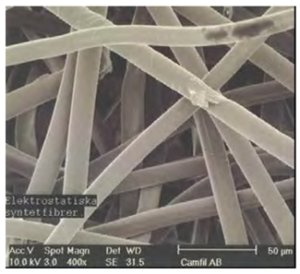
- Filter media: typically ultra-fine glass fiber, sometimes synthetic polymer fiber, arranged into an irregular mesh layer to optimize particle capture while maintaining stable airflow.
- Separator: placed between the pleats of the filter to maintain even spacing and prevent collapse — can be made of aluminum foil (durable, heat-resistant) or hot-melt adhesive (reduces risk of metal contamination).
- Frame: made of aluminum (lightweight, corrosion-resistant), stainless steel (for harsh environments), or plastic/MDF (for less critical applications).
- Adhesive: bonds the filter media to the frame, typically polyurethane, epoxy, or silicone, and must remain stable against temperature fluctuations and disinfection cycles.
- Sealing gasket: ensures an airtight connection between the filter and the housing — may be neoprene, silicone/PU foam, or gel seal for critical sterile areas.
All materials used must be compatible with cleanroom sanitizing agents and withstand repeated disinfection cycles. Each filter must also be clearly labeled (serial number, efficiency class) to support traceability in qualification records.
Why Is HEPA Important for the Pharmaceutical Industry?
- Contamination control: HEPA filters remove both non-viable particles (dust, fibers, aerosols — which can carry microorganisms) and viable particles (bacteria, fungi, viruses) that can directly contaminate the product.
- Cleanroom classification: Cleanroom classification cannot be achieved or maintained under ISO 14644-1 and Annex 1 without an effective air filtration system. Grade A requires the equivalent of ISO Class 5 both at rest and in operation; Grade B also achieves ISO Class 5 at rest; Grade C and D correspond to roughly ISO Class 7–8 depending on process requirements.
- Regulatory compliance: Under Annex 1 (2022 revision), air supplied to Grade A and B areas must pass through a HEPA filter. Filters must undergo integrity testing after installation, after maintenance, and at least annually; a visual airflow survey (smoke study) confirming unidirectional flow is also required.
- Protection of critical processes: particularly for sterile filling lines, sterilizing-grade filtration, preparation of high-risk injectable solutions, and final container closure operations.
Installation and Qualification of HEPA Filters
Proper installation and qualification directly determine the ability to maintain cleanroom classification over time. Both Annex 1 (2022) and ISO 14644-3 emphasize rigorous initial qualification, periodic requalification, and preventive maintenance.
Key installation considerations: ensuring correct airflow direction, secure mounting within the frame to prevent edge leakage, checking gasket or gel-seal compression, and protecting the filter from mechanical damage during handling.
Key qualification methods include:
| Test Type | Purpose | Frequency | Applies To |
| PAO/DOP | Confirm no leakage | After installation & annually | Grade A/B |
| Smoke study | Confirm airflow direction and pattern | After major changes | Grade A/B |
| Air velocity measurement | Measure unidirectional airflow velocity (0.36–0.54 m/s) | During qualification | Grade A |
| Differential pressure | Maintain directional pressure barrier | Continuous monitoring | All areas |
All installation, qualification, and requalification records must be fully retained, in alignment with the facility’s Contamination Control Strategy (CCS) and maintenance plan.
Selection Criteria for HEPA Filters in GMP Cleanrooms
When selecting a filter, several factors must be considered together:
- Particle-capture efficiency: Grade A/B requires at least H14; Grade C/D may accept H13 if supported by a risk assessment within the CCS.
- Pressure drop and system compatibility: choose a filter with low initial pressure drop, matched to the airflow and static pressure of the existing HVAC system.
- Resistance to disinfecting chemicals: especially for areas that regularly use H2O2 vapor (VHP), the filter media, frame, gasket, and adhesive must all resist oxidation and corrosion.
- Environmental durability: ability to withstand temperature, humidity, and mechanical vibration during both operation and disinfection.
- Seal type: compression gaskets are suitable for Grade C/D with periodic inspection; gel-seal should be prioritized for Grade A and critical Grade B areas.
- Certification and traceability: use only filters individually tested and certified to EN 1822, ISO 29463, or equivalent standards, with labels clearly stating model, efficiency class, serial number, and manufacturing date.
Frequently Asked Questions
Why is 0.1–0.3 micron considered the hardest particle size to filter?
Because at this size, all filtration mechanisms (interception, impaction, diffusion) operate least effectively compared to other particle sizes.
How often should HEPA/ULPA filter integrity be tested?
Immediately after installation, then at least once a year, and any time maintenance activity could affect the filter’s seal integrity.
Can a ULPA filter replace a HEPA filter in a system originally designed for HEPA?
This should not be done without a thorough technical assessment, as ULPA filters create higher pressure drop, which may exceed the capacity of the existing fan and disrupt airflow balance.
What shortens a filter’s service life?
High particle loading, high humidity, chemical exposure, or inadequate pre-filtration; airflow fluctuations and frequent vibration also contribute to premature wear.
Conclusion
A HEPA filter is not merely a component within an HVAC system — it is a core part of a pharmaceutical facility’s overall contamination control strategy. Selecting the right filter type — based on cleanroom grade, process risk, environmental compatibility, and regulatory requirements — combined with precise installation and periodic qualification, forms the foundation for ensuring product quality, patient safety, and sustainable GMP compliance.
This article is for technical reference purposes only and does not replace in-depth regulatory or GMP consultation.